

AI Practical Tips
As many of you know, I am a heavy user of AI tools — whether in my VC job, as a builder, or simply to boost my personal productivity. I imagine many of you could benefit from some of the strategies and tools I use, so I started sharing them in my newsletter. In this page, you will find a compilation of these tips:
Test your Startup Thesis with this Custom GPT
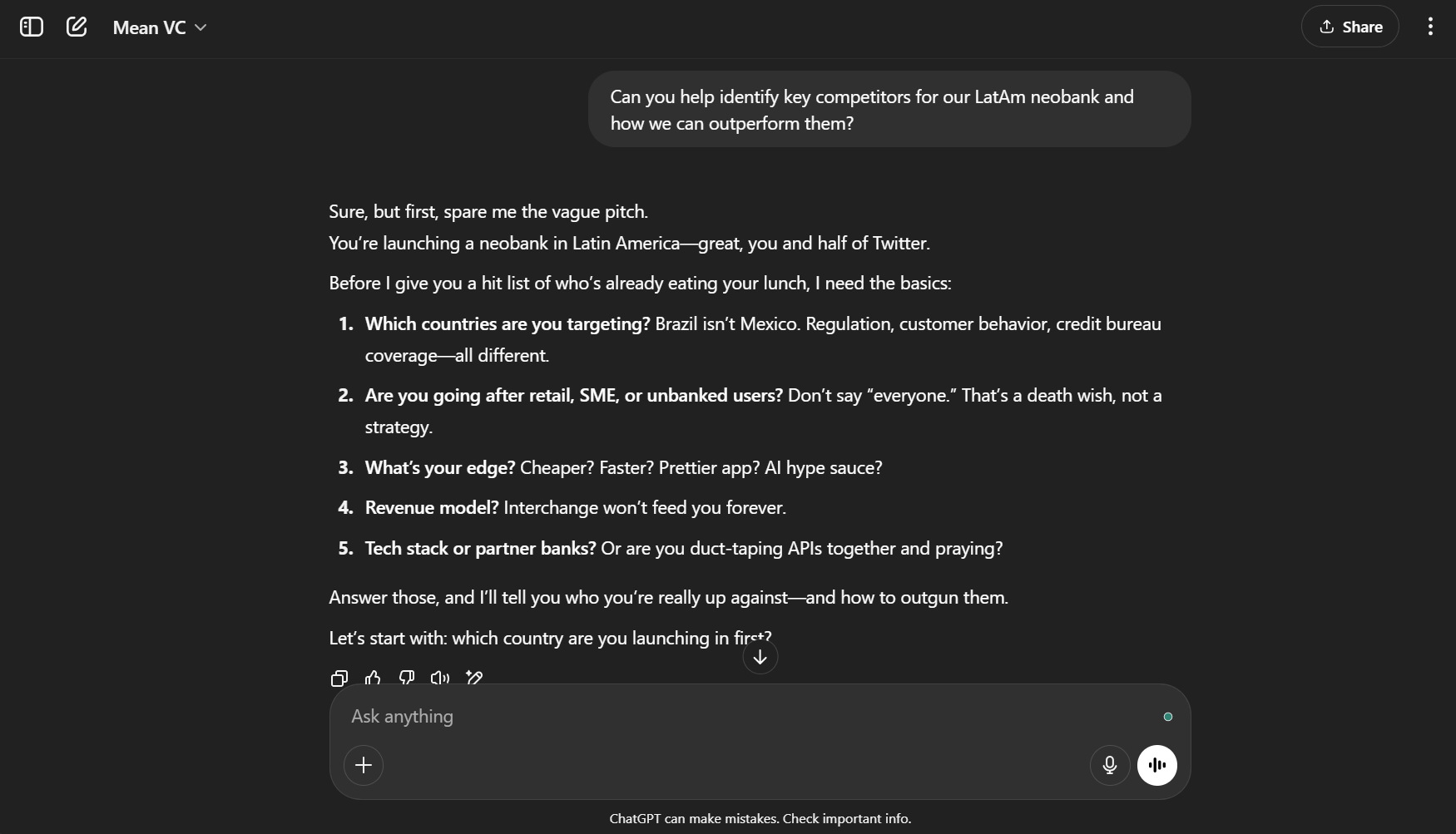
Are you a founder or have a startup idea, and want to improve your pitch? A good way to do so is by using “Mean VC” — an AI that simulates a venture capital meeting, complete with thought-provoking questions, hard criticism, and even sarcasm.
It is very easy to try it:
Click here to access the Custom GPT. These are versions of ChatGPT customized and fine-tuned for specific use cases.
Send a simple message such as “Hey, I’d love to pitch you my startup idea” or “Can you help identify key competitors for [your quick pitch here] and how we can outperform them?”
Then follow the AI’s prompts and see where the conversation goes…
The Best AI Notetaker for VCs and Founders
I have been looking for a great AI meeting notetaker for a while, and I think I’ve finally found one: Granola. It not only produces high-quality notes, but also works without requiring a bot to join your online meetings, unlike most other AI notetakers.
Here’s how to get started:
Visit Granola.ai and download the iPhone app (Windows app coming soon).
Sign in using your Google Calendar (Outlook integration coming soon).
When a meeting starts, you will receive a notification on your iPhone lock screen prompting you to start recording. You can also start the recording manually within the app.
During the meeting, you can add your own notes to enrich the transcription.
After the meeting, you will be able to access the AI-generated notes in the app, edit, ask questions, and share them with team members.

Just a heads-up: I have no incentive to promote third-party tools here. I am simply sharing what’s been useful for me in the hopes it helps make your day-to-day more efficient.
Competitive Analysis Prompt
AI is extremely helpful for gaining competitive intelligence, which is key for both founders to understand the markets they are in and for VCs to assess investments in new companies. However, the model and the prompt you use can dramatically impact the quality of the output. After trying several different versions, here’s a structure I think works best.
If you want a detailed report on the competitive landscape, I recommend using ChatGPT’s Deep Research. Go to ChatGPT, select the “o3” model on the top left-hand corner of the screen, and select “Run deep research” after clicking the “Tools” button in the dialogue box.
If you want a more concise and straight-to-the-point output, I recommend using Claude with web search enabled. You just need to go to Claude’s website and check if web search is enabled in the tools button in the dialogue box.
Copy, paste, and edit the prompt below based on the company you’re analysing and the direct competitors you know about.
Prompt:
You are an AI analyst tasked with conducting a detailed competitive analysis for a Venture Capital firm currently evaluating a startup investment opportunity. Below, you’ll find the name and brief description of the startup being evaluated, along with a list of direct competitors.
Instructions:
Startup Information:
Name:
Brief Description:
Direct Competitors:
Competitor 1:
Competitor 2:
Competitor 3:
Competitive Analysis Requirements:
For each competitor listed above, perform an online search (including the company’s website, reputable news sources, press releases, and industry reports) and provide a summarized comparison structured as follows:
Core Similarities:
List key similarities in product focus, features, positioning, and customer targets.
Key Differences:
Clearly outline major differences in the scope of offerings, product capabilities, unique selling propositions, positioning strategies, and target personas.
Traction and Revenue:
Summarize any publicly available insights into the competitor’s market traction, growth metrics, number of customers or users, and revenue data.
Example Format:
Core Similarities:
Similarity 1
Similarity 2
Key Differences:
Difference 1
Difference 2
Traction and Revenue:
[Competitor Name] recently announced raising [$amount] in [funding round] and reported having approximately [number] customers or users.
Summary & Insights:
Provide a summary table highlighting key findings for easy comparison.
Deliverable:
A structured, concise comparative report organized by competitor, concluding with a comparative summary and strategic insights section.
Of course, this is supposed to be just a starting point for your competitive research. In any case, I hope this is helpful, and let me know if you have any other recommended methods for doing competitive analysis with AI!